AI Visibility Is Not Enough: You Still Need to Know What Broke on Your Website
AI can recommend your product, but it can't tell you when your latest deployment quietly slowed down your website. Learn why ongoing SEO monitoring and performance regression monitoring matter just as much as AI visibility.
Over the past year, AI visibility has become one of the hottest topics in SEO. Brands are investing time in getting mentioned by ChatGPT, Gemini, Claude, and other AI assistants because these platforms are becoming another way people discover products and services.
That strategy makes sense. If AI recommends your product, more potential customers will eventually visit your website. But there’s one problem that doesn’t get nearly enough attention.
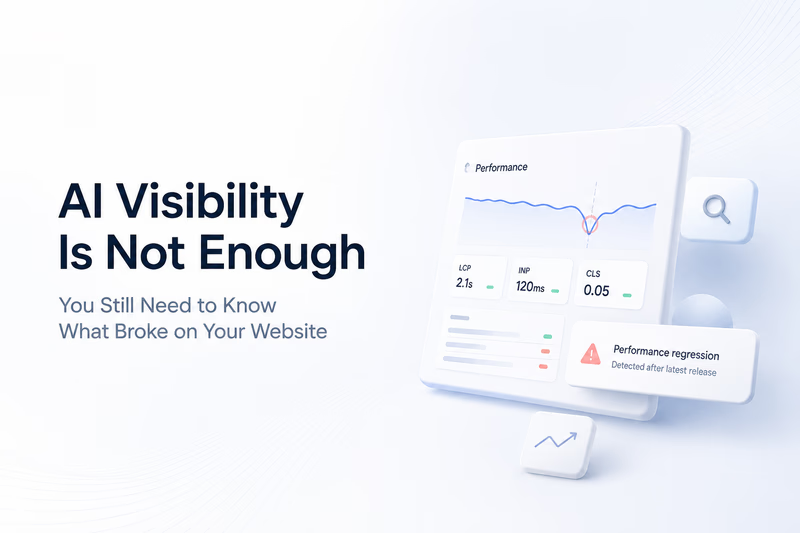
AI can bring visitors to your website, but it has no idea what happens after they click. If your latest deployment slowed down product pages, increased JavaScript execution time, or quietly hurt Core Web Vitals, AI won’t warn you. From the user’s perspective, the recommendation was good. The experience wasn’t.
That’s why AI visibility should never replace ongoing SEO monitoring. In reality, it makes continuous monitoring even more important.
AI Doesn’t Eliminate Technical SEO
Some people talk about AI as if it’s replacing traditional search. In reality, it’s simply becoming another acquisition channel.
Whether someone arrives from Google Search, ChatGPT, or Perplexity, they still expect the same thing: a fast, responsive website that works properly.
If pages become slower after a release, interactive elements stop responding, or layouts become unstable, visitors won’t care where they came from. They’ll simply leave.
The same applies to search engines. Google still evaluates user experience, and website performance remains one of the signals that influences long-term SEO success. AI visibility may increase awareness, but technical SEO monitoring is still what protects the quality of the experience after the click.
Most Website Performance Issues Don’t Happen Overnight
One of the biggest mistakes teams make is assuming performance problems are obvious.
They’re usually not.
Most website performance issues appear gradually. A new marketing script adds a little more JavaScript. A personalization platform introduces additional network requests. Another release increases bundle size by a few hundred kilobytes. None of these changes are serious enough to stop a deployment, so they go unnoticed.
Several weeks later, the website is noticeably slower than before, yet nobody can confidently explain why.
This is exactly where performance regression monitoring becomes valuable.
Instead of looking only at today’s Lighthouse report, regression monitoring compares every deployment with previous results and highlights performance regressions after releases before they become visible to users or search engines.
SEO Traffic Drops Usually Start Long Before Rankings Change
When organic traffic begins to decline, teams often start looking for external reasons. Maybe Google released a core update. Maybe competitors improved their content. Maybe seasonality changed demand.
Sometimes those explanations are correct. Quite often, though, the real cause is hidden inside the website itself.
A frontend update increased rendering time. A third-party integration affected responsiveness. Core Web Vitals slowly deteriorated across hundreds of pages without triggering any obvious alarms.
This is why every SEO traffic drop investigation should begin with a review of recent website changes, not just Search Console graphs. Historical performance data often explains problems much faster than ranking reports because it shows exactly when metrics started changing.
Reports Tell You What Happened. History Tells You Why.
Most SEO platforms are good at describing the current state of a website. They show Lighthouse scores, Core Web Vitals, and pages that need optimization.
What they rarely show is the timeline behind those metrics.
Did performance change yesterday or two months ago? Which release introduced the regression? Did every page become slower, or only product pages?
Answering those questions requires more than periodic audits. It requires SEO performance tracking that preserves historical data and allows teams to compare performance over time instead of treating every audit as an isolated event.
By the time SEO alerts appear or rankings begin to fluctuate, the underlying problem may already have existed for weeks. Finding and fixing it becomes significantly harder because dozens of additional deployments have already happened.
Visibility Gets the Click. Monitoring Protects the Experience.
AI assistants will continue changing how people discover brands online, and earning recommendations inside AI-generated answers will become an increasingly valuable marketing channel.
What won’t change is the importance of the website itself.
Visitors still expect fast pages. Google still rewards good user experience. Development teams will continue shipping new code every week, and every deployment carries the risk of introducing new regressions.
AI visibility helps people find your business. Ongoing SEO monitoring, technical SEO monitoring, and performance regression monitoring help ensure those visitors don’t arrive on a website that’s quietly becoming slower with every release.
The companies that succeed over the next few years won’t be the ones with the highest AI visibility alone. They’ll be the ones that combine visibility with continuous monitoring, detect regressions early, and solve problems before users and search engines notice them.