
Most Websites Don’t Break Instantly. They Decay Slowly
Most performance problems don’t start with one catastrophic release. Modern websites usually decay slowly as scripts, frontend updates, tracking systems, and third-party integrations gradually make pages heavier, less stable, and harder to maintain over time.
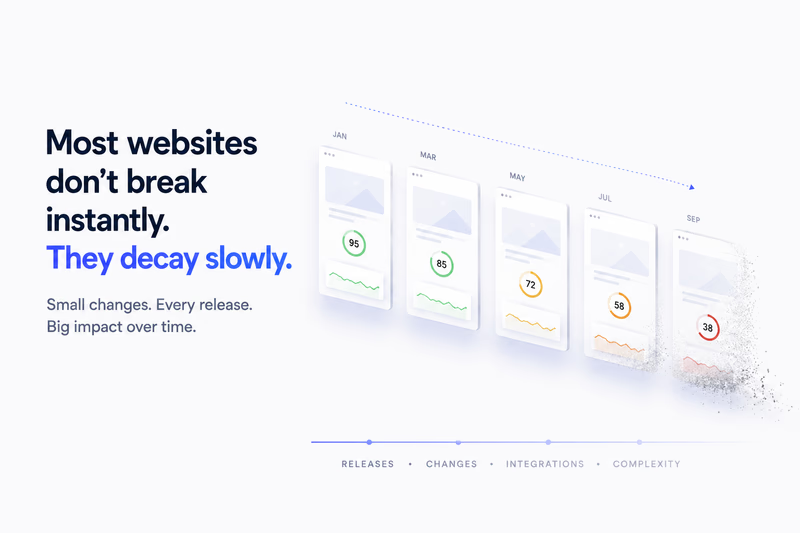
Most websites don’t break in one catastrophic release. They decay slowly. It’s performance degradation over time, as scripts, frontend updates, tracking systems, and third-party integrations gradually make pages heavier, less stable, and harder to maintain. No single change looks dangerous. The damage comes from dozens of them piling up between audits, until rankings, conversions, or customer experience finally start to reflect it.
Why most performance problems start quietly
Most sites don’t collapse after one bad deployment. Degradation begins much more quietly. A tracking script gets added before a campaign. A recommendation widget expands across product pages. A frontend component gets a little heavier after a redesign. Marketing installs another analytics integration before Black Friday. Developers push a release that changes how templates load dynamic content.
Individually, none of these look dangerous. The problem is that modern ecommerce sites rarely make just one change at a time. Over weeks and months, dozens of small technical decisions start interacting underneath the surface. JavaScript execution gets heavier, rendering behavior grows less predictable, and mobile responsiveness slowly degrades across important templates. That is how most regressions actually begin: not with one dramatic failure, but with gradual decay that spreads quietly until rankings, conversions, or customer experience reflect the damage.
Why traditional audits miss the real problem
One of the biggest misconceptions inside SEO teams is that occasional audits are enough to keep visibility over website health. A Lighthouse audit can absolutely catch important technical issues. The problem is that most sites evolve continuously between audits.
A homepage may still look healthy during a scheduled review while deeper templates already behave very differently in the real world. Product pages accumulate rendering instability after several releases land close together. Collection pages get slower after merchandising systems, recommendation engines, and tracking integrations all compete for browser resources at once. This is why isolated audits often can’t explain why rankings changed weeks later. The report captures a snapshot; the website keeps evolving after it was taken.
Why performance regressions usually appear after releases
Most serious regressions after releases aren’t caused by one obviously broken deployment. The more common scenario looks like this: a frontend team ships a redesign, marketing installs additional tracking for campaign attribution, a third-party app expands across product templates, recommendation widgets start loading more aggressively on mobile, and developers keep shipping every week because the business keeps moving.
Nobody intentionally damages performance. But over time the platform accumulates operational complexity that changes how pages render underneath the surface. That complexity eventually shows up in:
- Core Web Vitals metrics
- mobile responsiveness
- interaction latency
- rendering stability
- conversion rates
- search visibility
By the time rankings noticeably drop, the underlying degradation has often existed for weeks.
Why large ecommerce websites need continuous visibility
This gets much harder on enterprise ecommerce sites where hundreds or thousands of URLs evolve at the same time. Different templates behave differently. Product pages accumulate scripts faster than the homepage. Mobile rendering changes after releases. Third-party systems affect only certain URL groups. Search pages, collection pages, and localized templates can all perform differently depending on how integrations interact inside the frontend stack.
This is why many SEO teams are moving toward continuous Core Web Vitals monitoring instead of relying on occasional reviews. The goal is no longer running another Lighthouse audit every month. Modern teams increasingly need enough historical visibility to:
- detect performance regressions early
- understand when degradation started
- identify unstable templates
- compare behavior before and after releases
- monitor thousands of URLs continuously
- track rendering changes over time
Without that visibility, technical decay is very hard to notice before business metrics are already affected.
Why bulk Lighthouse audits became necessary
On modern ecommerce platforms, checking a few representative pages is no longer enough. A homepage can pass technical reviews while hundreds of product pages quietly get slower after new integrations expand. Certain templates fail only under specific mobile conditions. Some rendering problems appear only after several frontend systems interact at once.
This is exactly why bulk Lighthouse audits and recurring Lighthouse audits became important for large websites. Teams now need to see patterns across entire groups of pages rather than isolated URLs. A single Lighthouse report may look healthy while a broader monitoring view tells a very different story.
Why web vitals monitoring is becoming an operational requirement
For many ecommerce companies, web vitals monitoring is no longer just an SEO task. It became an operational requirement. Modern sites continuously evolve between releases, campaigns, frontend updates, app installations, personalization experiments, and analytics changes. Every new integration slightly changes how browser resources are prioritized, how rendering behaves, and how users experience the site in the real world.
The companies performing best long term usually aren’t the ones reacting fastest after rankings decline. They are the ones catching technical degradation early enough to prevent the decline in the first place.
What slow decay means for your team
Most websites don’t break instantly. They decay slowly, through hundreds of small technical decisions that accumulate across releases, integrations, scripts, frontend updates, and operational changes. That gradual decay is exactly why performance became so much harder to manage on modern ecommerce sites. Isolated audits still have value, but they no longer give enough visibility for platforms that continuously evolve underneath the surface. That is why more SEO and ecommerce teams are adopting recurring Lighthouse audits, continuous web vitals monitoring, and broader systems that can catch regressions before rankings and customer experience are seriously affected.