
Why Core Web Vitals Problems Usually Start Long Before Rankings Drop
Most websites do not suddenly become slow. Performance usually degrades gradually after releases, scripts, frontend updates, and third-party tools quietly damage LCP, CLS, and other Core Web Vitals metrics across the site.
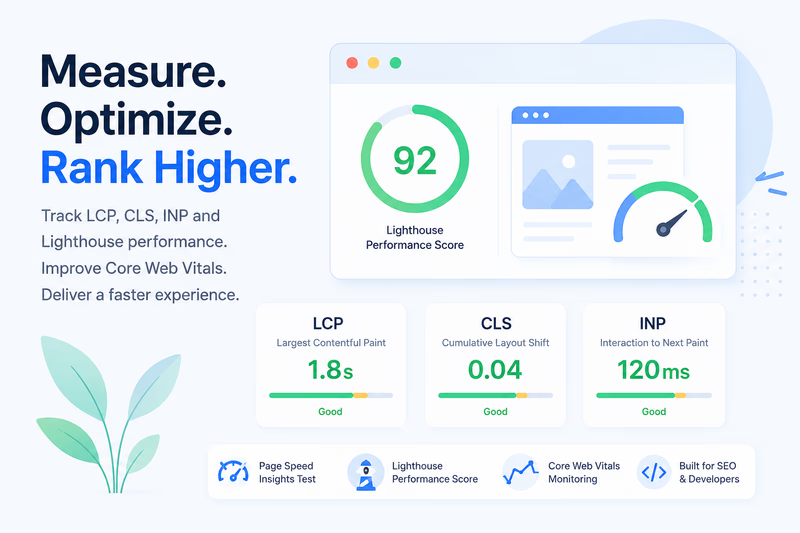
Most websites don’t become slow overnight. Core Web Vitals problems start long before rankings drop because performance degrades gradually: a script here, a frontend release there, another tracking tool, an update that nudges JavaScript execution up. Each change looks harmless on its own, but together they erode LCP, CLS, and INP across the site. And since most teams only spot-check a few pages, the damage spreads quietly for weeks before it shows up in rankings or conversions. That makes Core Web Vitals a leading indicator: they degrade first, and rankings follow.
Why LCP and CLS matter more than most teams realize
When people talk about website performance, they often focus only on loading speed. But modern SEO performance is tightly connected to user-experience metrics like LCP and CLS. Largest Contentful Paint (LCP) measures how fast the main content becomes visible. Cumulative Layout Shift (CLS) measures visual stability while the page loads. If buttons jump around, images shift, or the layout moves unexpectedly during load, CLS gets worse, and users notice immediately.
That is why Google increasingly uses these signals as part of overall page-quality evaluation. For SEO teams, monitoring LCP and CLS stability is no longer optional, especially on large ecommerce sites where templates, filters, personalization systems, and third-party integrations constantly affect rendering.
Why INP is becoming more important
For years, optimization discussions focused mainly on loading speed. Now interaction quality matters just as much. INP measures how responsive a site feels when users actually interact with it. A page can load quickly and still feel sluggish when people click buttons, open menus, apply filters, or type into search fields. This is one reason many sites get decent Lighthouse scores on desktop while mobile interaction quietly suffers, and mobile problems are often the hardest to detect manually at scale.
Why Lighthouse performance scores can be misleading
A lot of teams treat the Lighthouse performance score like a school exam. If the homepage scores above 90, everybody relaxes. The problem is that homepage scores rarely reflect the whole website. Modern sites generate thousands of unique page states through:
- dynamic filters
- faceted navigation
- search pages
- pagination
- campaign URLs
- localization
- product variations
One page may score 94 while another template quietly fails multiple Core Web Vitals thresholds. That is why experienced SEO and speed developer teams increasingly monitor performance across large groups of URLs instead of relying on isolated page speed checks.
Why PageSpeed Insights tests aren’t enough alone
Tools like PageSpeed Insights are useful for identifying technical issues. But running a single PageSpeed Insights test by hand every few weeks is no longer enough. Websites constantly evolve: frontend components change, scripts get updated, marketing tools inject new JavaScript, plugins affect rendering. Without recurring monitoring, technical degradation accumulates release after release. That is especially dangerous for ecommerce sites and large content platforms, where problems can spread across thousands of pages fast. That is why more SEO teams combine:
- recurring Lighthouse audits
- automated PageSpeed monitoring
- Core Web Vitals tracking
- historical performance analysis
- regression detection after releases
The goal isn’t a high score once. It is maintaining stable technical performance continuously.
Why technical SEO is becoming performance-driven
Modern technical SEO is increasingly tied to frontend stability and real user experience. Today SEO teams need visibility not only into metadata and crawlability, but also into:
- rendering performance
- interaction latency
- layout stability
- JavaScript impact
- mobile responsiveness
- Lighthouse regressions
The sites performing best long term usually aren’t the ones reacting fastest after rankings decline. They are the ones catching regressions before users and Google fully feel the impact.
What early decay means for your rankings
Most websites don’t lose rankings to one catastrophic failure. They lose them gradually, through dozens of small changes that slowly damage Core Web Vitals. A plugin here. A tracking script there. A release nobody fully tested on mobile. Eventually the site gets slower, less stable, and harder to interact with. That is why recurring monitoring of LCP, CLS, INP, and Lighthouse performance-score trends is becoming one of the most important parts of modern technical SEO, because by the time traffic visibly declines, the performance issues have usually existed much longer underneath the surface.