
Your Next Website Visitor May Be an AI Agent. Is Your Site Ready?
AI agents still depend on URLs, redirects, rendering, HTTP responses, and reliable access to your content. Learn why technical regression monitoring may matter more for AI readiness than another GEO checklist.
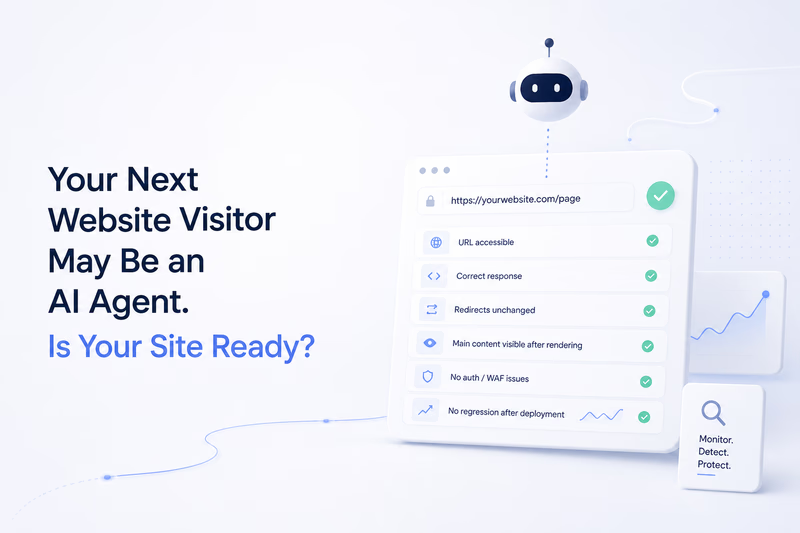
For years, websites have been built around two main visitors: people and search engine crawlers. That model is starting to change. AI assistants are moving from simply answering questions to researching products, comparing services, reading documentation, checking prices, and performing tasks on behalf of users. In many cases, the next visitor to your website may not be a person clicking a blue link in Google. It may be software trying to retrieve and understand the same information for them.
Most of the discussion around preparing websites for this shift has focused on AI visibility: structured content, schema, `llms.txt`, citations, and ways to make information easier for language models to understand. Those things may matter, but they skip a more basic question. Can the agent reliably access the page in the first place?
A perfectly structured page isn’t particularly useful if its URL suddenly returns a 403, an old redirect sends automated visitors somewhere else, or the main content disappears after rendering. Before worrying about whether an AI system understands your website, you need to know whether the technical path between the agent and your content still works.
AI Agents Still Have to Deal With Your Infrastructure
AI agents may be new, but many of the problems they encounter are not. They still request URLs, receive HTTP responses, follow redirects, encounter authentication systems, interact with CDNs and WAFs, and eventually need access to the content your application produces.
That creates a fairly straightforward technical checklist. Is the URL available? Does it return the expected response? Have redirects changed? Is the main content present after rendering? Is an authentication or WAF rule blocking access? Did any of this change after the latest deployment?
These questions sound more like traditional technical SEO than AI optimization, and that’s exactly the point. You don’t necessarily need another AI-specific checklist. You need reliable technical monitoring that catches changes before they turn into visibility or accessibility problems.
200 Response Doesn’t Always Mean the Page Works
One of the easiest mistakes in website monitoring is treating HTTP 200 as proof that everything is fine. The server responded successfully, so the page must be available. In reality, plenty can go wrong between receiving that response and actually getting usable content.
A frontend deployment can leave the page technically available while breaking rendering. An API failure can produce an empty product grid inside an otherwise healthy HTML document. A JavaScript error can prevent important content from appearing. A consent layer or authentication change can cover the content entirely. None of these necessarily produces a clean server error that immediately gets someone’s attention.
This is also why an on page optimization checker or a conventional SEO audit only tells part of the story. It can identify problems in the page it sees at the moment of the test, but it doesn’t necessarily tell you that yesterday the same page rendered correctly and today’s deployment changed that behavior.
For AI agents, that distinction matters. A URL being technically reachable and a URL delivering useful content are not the same thing.
## Redirect Changes Can Quietly Break Access
Redirects are another good example of a small technical change with potentially large consequences. Sites accumulate redirects over years through migrations, URL restructuring, internationalization, campaign pages, canonicalization changes, and product updates. Most of the time they work quietly in the background, which is why unexpected changes can survive unnoticed.
A deployment might introduce an additional hop, redirect a page to the wrong locale, create a loop, or send automated visitors somewhere different from regular browser traffic. The website still exists and other pages continue working, so there may be no obvious incident to investigate.
A traditional online SEO analysis report may eventually expose the issue during the next audit. Technical regression monitoring takes a different approach: it detects that the behavior of a monitored URL has changed. The important signal isn’t simply “this URL redirects.” It’s “this URL didn’t redirect this way before.”
That difference becomes increasingly important as more types of automated visitors interact with websites.
## WAF and Authentication Rules Are Part of AI Readiness Too
Security infrastructure creates an even more interesting problem. Websites increasingly rely on bot management, rate limiting, authentication layers, CDN rules, and web application firewalls. These systems are necessary, but automated traffic doesn’t always fit neatly into the distinction between “good user” and “bad bot.”
A configuration change can leave the website perfectly accessible to a human using Chrome while producing a completely different response for an automated client. From the company’s perspective, nothing appears broken. From the agent’s perspective, the website has effectively disappeared.
This is why periodic checks from an online SEO report generator or online SEO report tool shouldn’t be treated as a substitute for monitoring. Reports describe what was found during a particular crawl. They don’t automatically tell you that a URL’s accessibility changed three hours after a security configuration was deployed.
If AI agents become a meaningful source of discovery and interaction, monitoring those changes becomes part of maintaining the website, not a separate GEO exercise.
Lighthouse Is Useful, but Performance Scores Are Only One Signal
Performance adds another layer. Teams already use Google Lighthouse performance testing, Google PageSpeed Lighthouse, and other tools to understand how pages behave. Metrics from Lighthouse and Core Web Vitals can reveal slow loading, poor responsiveness, layout instability, and other user experience problems.
Those measurements remain useful for AI-era websites. Google Lighthouse Core Web Vitals and other Google page metrics can help identify whether a release has made a page heavier or slower, while Google PageSpeed performanc testing gives teams a quick way to inspect the current state of a page. Lighthouse can also be run directly through Chrome DevTools or as part of automated workflows, rather than treating a Google Lighthouse download as the monitoring strategy itself.
The limitation is the same one we see with SEO audits: a test gives you a result for a particular moment. The harder question is whether that result changed.
A performance score of 72 tells you something about the page today. Knowing that it scored 91 before Tuesday’s deployment tells you considerably more.
The Real Problem Is Regression
This is where technical regression monitoring becomes the more useful way to think about AI readiness.
Instead of asking only whether the website passes today’s checks, you monitor whether important technical behavior has changed over time. A URL that returned 200 yesterday now returns 403. A product page that rendered its main content correctly last week now produces an empty container. A redirect destination changes. Lighthouse performance drops after a frontend release. A WAF update suddenly blocks a class of automated requests.
None of these problems is fundamentally about AI. They’re regressions.
That’s useful because it keeps AI readiness connected to the same operational discipline teams already need for SEO and web performance. You don’t have to predict every way future agents will interact with your website. You need to know when the technical behavior of important pages changes unexpectedly.
Ranking Reports Won’t Tell You What Broke
SEO teams are already used to monitoring outcomes. Ranking report software, a Google ranking report tool, or a regular search ranking report can show when positions start moving. Google ranking report software can help teams track those changes across hundreds or thousands of queries.
The problem is timing. Ranking data often tells you about the consequence after something has already happened. It doesn’t necessarily tell you what changed on the website before the decline began.
Technical regression monitoring moves the observation point closer to the cause. Instead of waiting for rankings, traffic, or AI visibility to change, you detect the broken redirect, failed response, rendering issue, performance regression, or access problem when it appears.
That makes investigation much easier. If a monitored page changes immediately after deployment 1842, the engineering team has somewhere concrete to start. If all you know is that search visibility declined three weeks later, the investigation becomes much broader.
AI Readiness Is Mostly About Keeping the Website Reliable
There will undoubtedly be new standards for AI agents. Some will become important, others will disappear after six months of enthusiastic LinkedIn posts. Right now, it’s too early to assume that adding one file or following one GEO checklist will make a website “AI ready.”
The safer approach is less fashionable but much more practical. Make sure important URLs remain accessible. Monitor their responses. Track redirects. Verify that meaningful content still appears after rendering. Watch for authentication and WAF changes. Measure performance and detect regressions after deployments.
If AI agents become regular website visitors, they will benefit from that reliability. So will Google. So will your customers.
That’s the useful connection between AI and technical SEO: you don’t need to rebuild your website around every new AI trend. You need to know when something that worked yesterday stops working today.