
Performance Regression Monitoring: The Missing Part of SEO
One-time Lighthouse audits only show a snapshot. Discover how performance regression monitoring helps identify performance regressions after releases before they impact rankings.
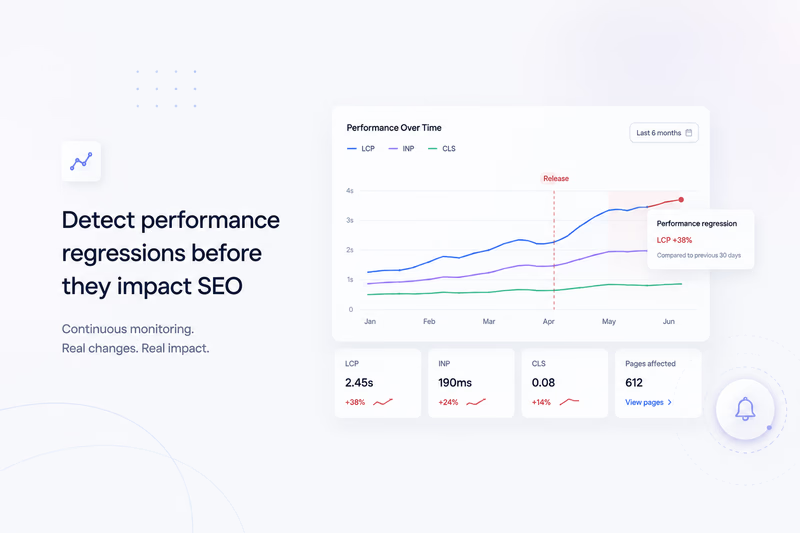
If you’ve worked with large websites long enough, you’ve probably seen this happen.
Organic traffic starts slipping. Rankings become unstable. Core Web Vitals look slightly worse than they did a few months ago.
The first reaction is usually to look for a single cause. Maybe Google released another update. Maybe the hosting provider had issues. Maybe developers introduced a serious bug.
In reality, that’s rarely what happens.
Most websites don’t become slower overnight. They get slower one release at a time.
A new analytics script here. An extra JavaScript dependency there. A redesigned product page. Another third-party widget added by marketing. None of these changes look dramatic in isolation, so they make it through deployment without raising any alarms.
Six months later, the site is noticeably heavier, LCP has increased, user experience has declined, and nobody can confidently answer one simple question:
When did this start?
That’s the gap performance regression monitoring is designed to fill.
Lighthouse Tells You Where You Are. It Doesn’t Tell You How You Got There
Lighthouse is an excellent diagnostic tool. It helps you understand how a page performs at a specific moment and highlights obvious optimization opportunities.
The problem is that it’s a snapshot.
Imagine checking your weight once a year. You’d know today’s number, but you wouldn’t know whether you’ve gained ten kilograms in the last month or gradually over several years.
Website performance works the same way.
A Lighthouse score of 88 doesn’t tell you whether that page has always scored around 88 or whether it dropped from 98 after the last three releases.
Without historical data, every investigation starts from scratch.
Performance Regressions Usually Look Small
One of the biggest misconceptions is that performance problems are always obvious.
They’re not.
A single release might increase LCP by 150 milliseconds.
Another adds a few hundred kilobytes of JavaScript.
A third introduces a marketing script that slightly delays rendering.
Individually, none of these changes are likely to trigger an incident. Together, they create the kind of performance regressions that slowly affect Core Web Vitals, conversion rates, and eventually SEO.
By the time someone notices a meaningful decline in organic traffic, the original change may be buried under dozens of subsequent deployments.
Why Performance Regressions After Releases Matter
Modern websites change constantly.
Development teams ship new features every week. Marketing adds tracking scripts. Product managers run experiments. Third-party services update their own code without asking anyone.
Every release is another opportunity for performance to improve - or quietly get worse.
That’s why more engineering teams are starting to monitor performance regressions after releases instead of relying solely on scheduled Lighthouse audits.
Rather than asking whether the website is fast today, they compare today’s metrics with yesterday’s, last week’s, or the previous deployment. When something changes unexpectedly, they know exactly when it happened and which pages were affected.
That makes debugging dramatically easier.
The Problem Isn’t Finding Slow Pages
Most SEO tools can tell you that a page is slow.
The difficult part is understanding why it became slow.
Did performance drop after the checkout redesign?
Was it caused by a new personalization platform?
Did an advertising script increase Total Blocking Time across every product page?
Traditional reports rarely answer those questions because they focus on the current state rather than the history behind it.
That’s where performance regression monitoring becomes valuable. Instead of producing another performance score, it shows how your website evolves over time and highlights the exact moment something starts moving in the wrong direction.
Don’t Wait Until SEO Starts Telling You Something Is Wrong
SEO metrics are often the last place where performance issues become visible.
By the time impressions decline or rankings begin to move, users have already been experiencing a slower website for weeks or even months.
Fixing a regression is almost always easier when it’s discovered after one deployment than after fifty.
That’s why continuous monitoring is becoming part of the workflow for larger websites. Not because Lighthouse is no longer useful - it absolutely is - but because snapshots alone aren’t enough when your site changes every week.
If you’re only measuring today’s performance, you’re missing the story that actually explains why it changed. And in many cases, that story is exactly what helps you prevent SEO problems before they become visible in Search Console.